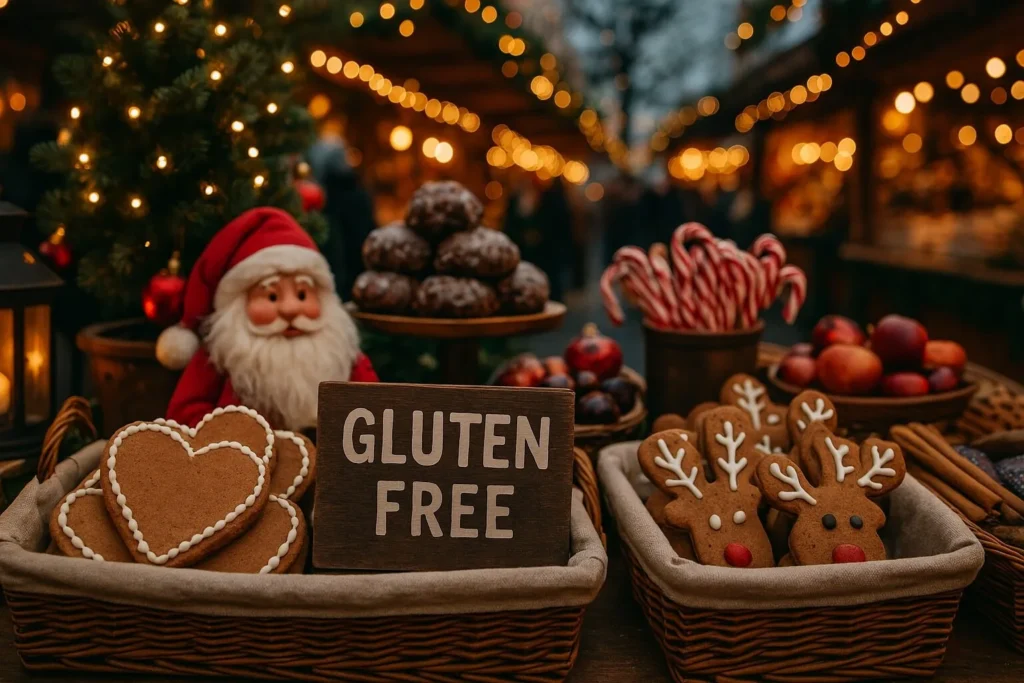
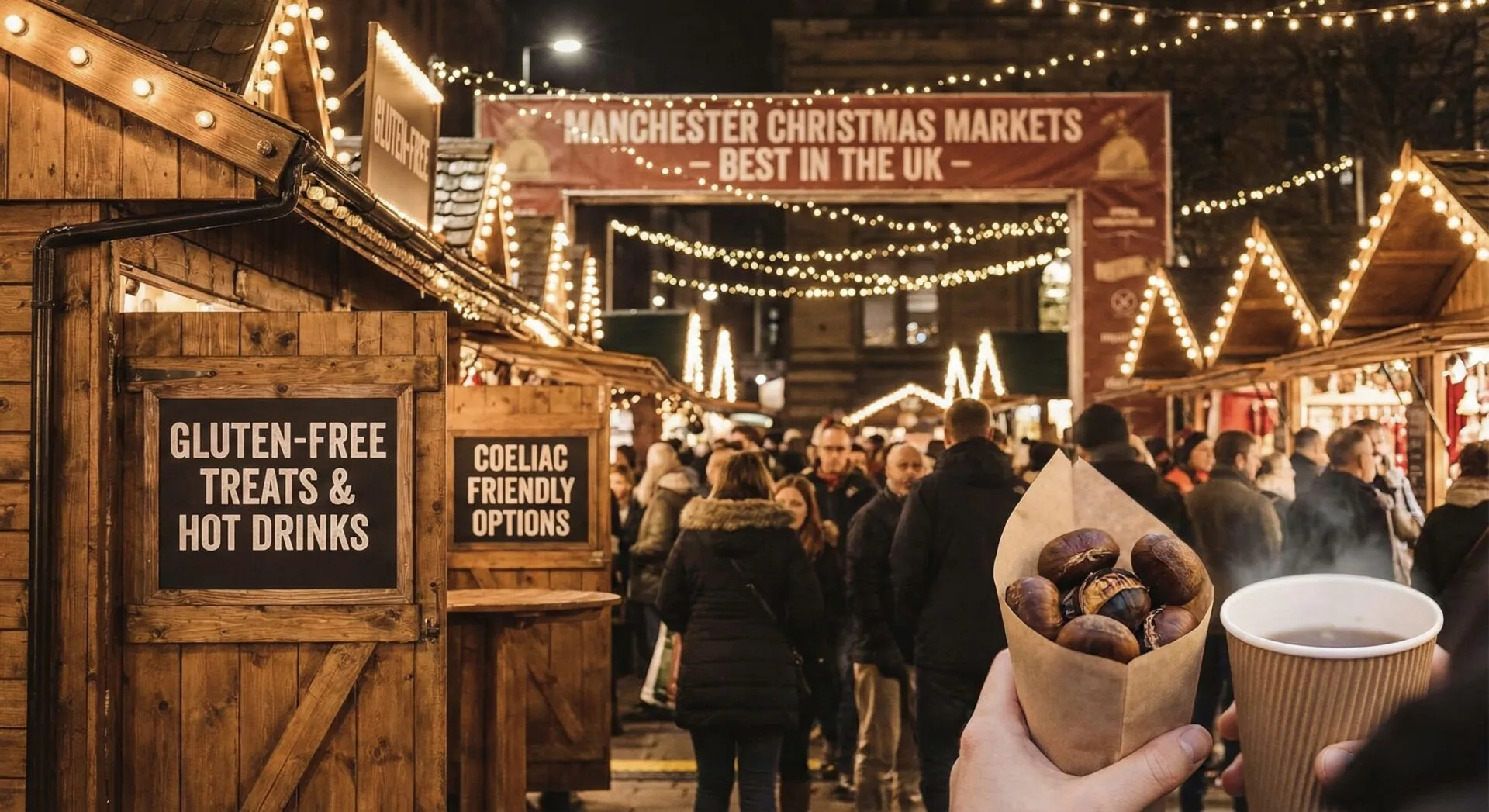
The twinkling lights, wooden chalets, and wafting aroma of roasted chestnuts draw millions to Britain’s Christmas markets each year—but for those of us with coeliac disease, that festive magic often comes with a side of anxiety. The good news? UK Christmas markets have become significantly more coeliac-friendly in recent years, with improved allergen labelling, dedicated gluten-free vendors, and plenty of naturally gluten-free treats if you know where to look. This guide will help you navigate the best UK markets for 2025 with confidence.
Manchester Christmas Markets emerges as the clear winner for coeliacs, consistently praised by gluten-free bloggers as “the best in the UK by a mile.” But whether you’re exploring Birmingham’s authentic German stalls or skating at London’s Winter Wonderland, you can still enjoy the festive atmosphere with a little preparation. Here’s everything you need to know.
Manchester deserves its crown as the UK’s most coeliac-friendly market
If you can only visit one Christmas market this year, make it Manchester. Running from 7 November to 22 December 2025 across ten city centre locations with over 200 stalls, it’s not just the UK’s largest Christmas market—it’s also the most accommodating for those of us navigating gluten-free life.
Becky Excell, Sunday Times bestselling author and Coeliac UK ambassador behind Gluten Free Cuppa Tea, puts it plainly: “In my opinion it is by far the best Christmas market across the UK and one of the best in Europe.” What sets Manchester apart is the allergen labelling that now appears on virtually every single stand, making the experience far less stressful than playing ingredient detective at every stall.
The market has become a genuine pilgrimage for UK coeliacs, and several vendors have become annual must-visits. Clowbeck’s Farmhouse Kitchen offers gluten-free Cumberland sausages served in proper GF bread rolls—a rarity at any Christmas market. You’ll need to order 10-20 minutes in advance while they prepare your roll, but the wait is worth it for that authentic market experience of biting into a hot sausage in bread. They also serve bubble and squeak and navy mushrooms with black peas. Emerald City Cupcakes has earned a devoted following for their GF cupcakes, gingerbread men, and Christmas cakes—Alison Peters of Coeliac Sanctuary calls them “masters of delicious gluten free cake.”
The French Macarons stall offers 15 flavours, all naturally gluten-free (made with almond flour), and they keep for eight weeks—perfect for gifts. But the undisputed star, mentioned rapturously by every coeliac blogger who’s visited, is the Coconut Macaroons stall. “I AM IN LOVE,” writes Excell. “I cannot quite describe how good these are.” Made fresh with coconut, coconut milk, and egg, they’re naturally gluten-free and utterly addictive. As with any stall, ask how they’re made and stored.
For savoury options, Witch House serves gluten-free German sausages (bring your own bun or eat without), while Sillfield Farm Foods sells GF Cumberland, wild boar, pork, and chorizo sausages to take home. La Fromagerie has gluten-free cheesecake alongside their cheese selection, and Brooks Mill Coffee Bar confirms their hot chocolate contains no gluten or “may contain” warnings.
The major UK markets and their 2025 dates at a glance
Britain hosts an impressive array of Christmas markets each winter. Here’s what’s confirmed for 2025:
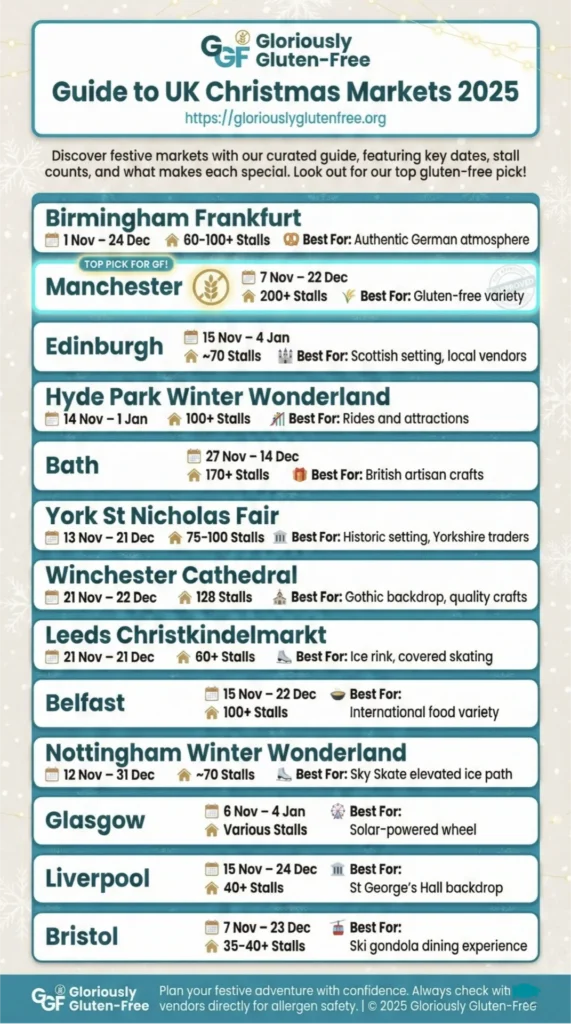
Birmingham Frankfurt Christmas Market celebrates its 25th anniversary in 2025 and remains the largest authentic German Christmas market outside Germany or Austria, attracting 5.5 million visitors. It’s predominantly traditional German fare—bratwurst, pretzels, schnitzel—which makes navigation trickier for coeliacs. Most German sausages are actually gluten-free (the meat itself contains no wheat), but the rolls aren’t, and cross-contamination from shared grills is a real concern. Coeliac Sanctuary has produced a dedicated Birmingham guide, suggesting the market is manageable with preparation, though it lacks the dedicated GF vendors Manchester offers.
Hyde Park Winter Wonderland now includes markers for “Gluten Free Options” at vendors in the Street Food Village, including Bad Brownie for GF brownies and NYC-style comfort food stalls. Emma Eats & Explores reports successfully finding flame-cooked salmon with salad, and roasted chestnuts are everywhere. Entry ranges from free (off-peak) to £7.50 (peak times), with attractions charged separately.
Edinburgh Christmas Market benefits from Scotland’s generally excellent gluten-free dining scene—Edinburgh has been called “the UK’s capital of gluten-free food.” The market offers gluten-free savoury galettes (buckwheat crepes) for £7.50, and over three-quarters of vendors are local Scottish businesses. The spectacular setting beneath Edinburgh Castle makes it worth visiting regardless.
Good bets: naturally gluten-free foods at every market
The secret to enjoying Christmas markets as a coeliac is knowing which foods are naturally gluten-free. These options appear at virtually every UK market:
Roasted chestnuts (Maroni) are your best friend—warm, filling, and naturally gluten-free. They’re sold at dedicated stalls throughout every major market and make a perfect warming snack as you browse. Mulled wine (Glühwein) is usually gluten-free too: it’s made from red wine, citrus, and spices like cinnamon, cloves, and star anise, all naturally gluten-free. Just verify no unusual additives or commercial mixes are used. The same goes for mulled cider.
Cheese stalls are abundant at UK markets, and cheese is naturally gluten-free. Cured meats and continental sausages (like those at Continental Cottage in Manchester) are often a good bet—many are just meat and seasonings, but some sausages use rusk or wheat fillers, so ask. French macarons, made with almond flour and egg whites, are naturally GF (though always confirm no flour is added). Nougat from Italian stalls is often gluten-free, as is most chocolate and fudge, but ask to see the ingredients, and watch out for fudge stalls using shared tongs, which pose cross-contamination risks.
Most German sausages are actually gluten-free. The Sausage Man, which supplies many UK Christmas markets, confirms almost all their varieties—including Bratwurst XXL, Beef Hot Dogs, and Chilli Beef Frankfurters—are gluten-free. The key is eating them without the bun or bringing your own GF roll. UK brands like Heck, Debbie and Andrew’s, and Black Farmer make gluten-free sausages too, but check the pack, as ranges change.
The hidden minefields: what to avoid and where gluten lurks
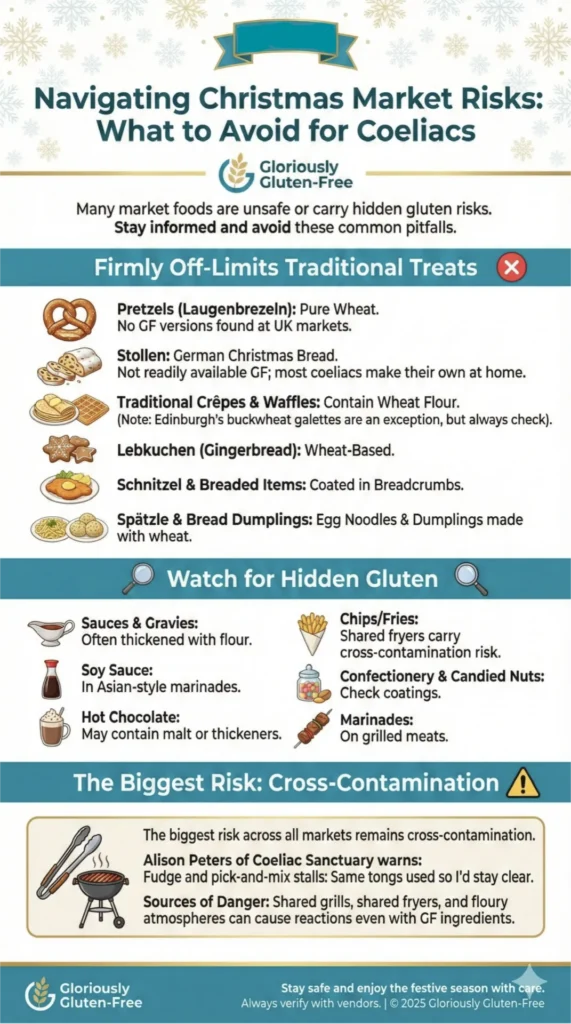
While Christmas markets offer more gluten-free options than many coeliacs realise, several traditional treats remain firmly off-limits:
Pretzels (Laugenbrezeln) are pure wheat. I’ve yet to find a GF version at any UK Christmas market. Stollen, that wonderful spiced German Christmas bread, isn’t readily available gluten-free anywhere—most coeliacs make their own at home using recipes from Coeliac UK or The Gluten Free Alchemist. Traditional crepes and waffles contain wheat flour, though Edinburgh’s galettes (made with buckwheat) are a notable exception. Lebkuchen (gingerbread), schnitzel (breaded), spätzle (egg noodles), and bread dumplings are all wheat-based, so give them a miss.
More insidiously, watch for hidden gluten in:
- Sauces and gravies thickened with flour
- Soy sauce in Asian-style marinades
- Hot chocolate containing malt or thickeners
- Chips/fries from shared fryers (contaminated by battered fish)
- Coatings on confectionery and candied nuts
- Marinades on grilled meats
The biggest risk across all markets remains cross-contamination. Alison Peters of Coeliac Sanctuary warns about fudge and pick-and-mix stalls: “Same tongs used so I’d stay clear.” Shared grills, shared fryers, and preparation in floury atmospheres can all cause reactions even when the food itself is gluten-free.
What the coeliac community really says about UK markets
The testimony of fellow coeliacs provides the most valuable guidance. Coeliac Sanctuary’s Alison Peters, diagnosed since 2014, offers measured praise for Manchester: “I was actually fairly impressed by how much gluten free was on offer, some parts of the market were better than others though!” She notes Albert Square and St Ann’s Square have the best GF options, while Market Street and Exchange Square are sparser. Her key frustration? “It would have been nice if there was more sweet options—come on Manchester, give me waffles and crepes next year!”
Peters also highlights a practical challenge: language barriers with European vendors. “I should have brought some of my Coeliac travel translation cards with me, the German, Spanish and Italian ones mostly, as some of the vendors did seem to be struggling with the language.”
From last year’s post about Christmas Markets, I mentioned a universal market problem: “Christmas markets are busy, and stalls may use shared surfaces for both gluten and gluten-free items.” I’d recommend London’s Southbank Market, which typically has dedicated vegan and gluten-free stands, and visiting earlier in the day for better availability.
Coeliac UK, through ambassador Frankie’s Family, offers sobering realism: “Most Christmas markets are sadly not places where gluten free food is easy to find or trust.” Their practical solution? “Our tip is to always keep a box of mini GF mince pies (or fudge) to hand and take a couple in a food bag while you’re out.”
Practical survival guide: questions, apps, and preparation
Essential questions to ask vendors: Before ordering anything, ask: “Is this gluten-free?” and “Do you use a separate fryer/grill/utensils for gluten-free items?” If staff seem uncertain or dismissive, move on. Request to see packaging or ingredient lists rather than relying on verbal assurances alone—Coeliac UK advises speaking to a manager to ensure your requirements are understood as a health necessity, not preference.
Apps and resources:
- Coeliac UK’s Live Well Gluten Free App (£14.99/year for members) includes a barcode scanner for 150,000+ products and a Venue Guide
- Gluten Free Scanner UK offers barcode scanning plus dining and travel cards
- Find Me Gluten Free helps locate nearby gluten-free options
- CeliacTravel.com offers free printable restaurant cards in 50+ languages
Prepare your kit: Bring gluten-free bread rolls (for sausages and hog roast), your own snacks in case options are limited, translation cards for European vendors, and the Coeliac UK helpline number (0333 332 2033) saved to your phone. Consider packing paracetamol, Buscopan, and peppermint tea in case of accidental glutening.
Timing matters: Visit on weekdays and earlier in the day for cleaner cooking surfaces, less rushed staff, and better GF availability. Peak times (8pm, weekends) mean maximum contamination risk and distracted vendors.
The legal landscape: Natasha’s Law and allergen requirements
A positive development for coeliacs: Natasha’s Law (October 2021) now requires all “Prepacked for Direct Sale” food at market stalls to display full ingredient lists with the 14 major allergens—including gluten—clearly emphasised. This explains the improved labelling Becky Excell noticed across Manchester’s stalls.
For food made fresh and sold loose, vendors must still provide allergen information, but it can be verbal, on menus, or via written notices directing customers to ask. The quality of this varies enormously between stalls. Coeliac UK’s Crossed Grain symbol indicates products meeting strict gluten-free standards—look for it at accredited venues.
Making memories, not mistakes
Christmas markets should be about joy, not anxiety. Armed with this guide, you can approach the UK’s festive markets with confidence. Manchester remains the clear winner for dedicated gluten-free options, but every major market has good choices if you focus on naturally GF foods, ask the right questions, and prepare properly.
The coeliac community continues to advocate for better options—Alison Peters’s call for GF waffles and crepes hasn’t gone unnoticed—and each year brings improvements. The combination of Natasha’s Law, increased awareness, and dedicated vendors like Clowbeck’s and Emerald City Cupcakes means we’re finally being properly catered for.
My final advice echoes that of every coeliac blogger who’s navigated these markets: bring backup snacks, don’t trust vague assurances, and never feel embarrassed about asking detailed questions. Your health matters more than momentary awkwardness. Now go enjoy those coconut macaroons—you deserve them.
Quick Reference: 2025 Market Dates
- Birmingham Frankfurt: 1 November – 24 December
- Manchester: 7 November – 22 December
- Edinburgh: 15 November – 4 January 2026
- Hyde Park Winter Wonderland: 14 November – 1 January 2026
- Bath: 27 November – 14 December
- York St Nicholas Fair: 13 November – 21 December
- Winchester Cathedral: 21 November – 22 December
- Leeds: 21 November – 21 December
- Belfast: 15 November – 22 December
Key Resources
- Coeliac UK: coeliac.org.uk
- Coeliac Sanctuary market guides: coeliacsanctuary.co.uk
- Gluten Free Cuppa Tea: glutenfreecuppatea.co.uk
- Coeliac UK Helpline: 0333 332 2033